

Table of Contents
Introduction
Every modern business generates enormous volumes of data—from customer interactions and website analytics to sales transactions, supply chain records, financial reports, IoT sensors, and social media engagement. While this data holds immense value, it is only useful when organizations can extract meaningful insights from it. This is where AI-powered data mining comes into play.
Traditional data mining methods often required extensive manual analysis, predefined rules, and significant technical expertise. Today, Artificial Intelligence (AI), Machine Learning (ML), Natural Language Processing (NLP), and predictive analytics have transformed data mining into a faster, smarter, and more scalable process.
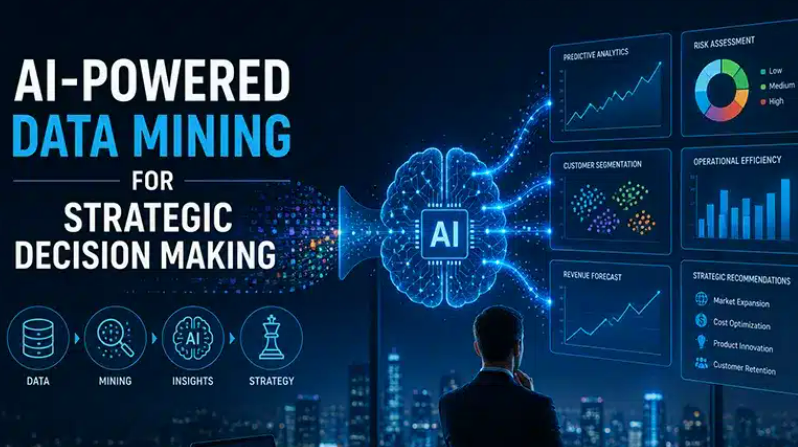
AI-powered data mining tools help businesses uncover hidden patterns, predict future trends, detect anomalies, segment customers, optimize operations, and support data-driven decision-making. Instead of spending weeks analyzing spreadsheets and databases, organizations can now generate actionable insights in minutes.

From startups to multinational enterprises, businesses across industries are leveraging AI-driven data mining to improve efficiency, enhance customer experiences, reduce operational costs, and gain a competitive advantage.
This article explores the role of AI in data mining, its benefits, the latest tools available in 2026, industry applications, best practices, and future trends shaping intelligent business analytics.
What Is Data Mining?
Data mining is the process of analyzing large datasets to discover meaningful patterns, relationships, trends, and insights that can support business decisions.
The process involves:
- Collecting data
- Cleaning and preparing data
- Identifying patterns
- Building predictive models
- Discovering relationships
- Visualizing insights
- Supporting strategic decisions
Modern AI significantly enhances every stage of this process by automating analysis and continuously improving accuracy.
What Is AI-Powered Data Mining?
AI-powered data mining combines traditional analytics with artificial intelligence technologies to automatically discover patterns, make predictions, and generate business insights.
Unlike conventional methods, AI systems can:
- Learn from historical data
- Identify hidden relationships
- Detect anomalies
- Predict future outcomes
- Analyze structured and unstructured data
- Recommend actions
This enables organizations to make faster and more informed business decisions.
Why Businesses Are Investing in AI Data Mining
Businesses are generating more data than ever before.
Sources include:
- CRM platforms
- ERP systems
- E-commerce websites
- Mobile applications
- Customer support systems
- Social media
- IoT devices
- Marketing campaigns
- Financial transactions
- Cloud applications
AI helps convert this growing volume of information into strategic intelligence.
Key benefits include:
- Faster decision-making
- Improved forecasting
- Better customer understanding
- Increased operational efficiency
- Reduced business risks
- Higher profitability
Key AI Technologies Behind Data Mining
Machine Learning
Machine learning identifies patterns from historical datasets and improves predictions over time.
Business applications include:
- Sales forecasting
- Customer segmentation
- Fraud detection
- Product recommendations
- Inventory optimization
Natural Language Processing (NLP)
NLP enables AI systems to understand and analyze text-based information.
Examples include:
- Customer reviews
- Emails
- Support tickets
- Contracts
- Social media posts
Businesses gain insights from unstructured text that would otherwise require manual analysis.
Deep Learning
Deep learning models process highly complex datasets such as:
- Images
- Audio
- Videos
- Large-scale customer behavior
- Financial market trends
These models uncover relationships that traditional algorithms may miss.
Predictive Analytics
Predictive analytics estimates future outcomes using historical data and AI models.
Organizations use predictive analytics to:
- Forecast demand
- Predict customer churn
- Optimize pricing
- Improve sales planning
- Reduce operational risks
Top AI Tools for Business Data Mining in 2026
1. Microsoft Power BI with AI Features
Power BI combines business intelligence with AI capabilities, enabling organizations to visualize data, identify trends, and generate predictive insights.
Key features include:
- AI-powered dashboards
- Natural language queries
- Automated insights
- Forecasting
- Data visualization
- Real-time reporting
Best for:
Small businesses to enterprise organizations.
2. Tableau AI
Tableau integrates AI-driven analytics with interactive dashboards.
Businesses can explore data visually while receiving intelligent recommendations.
Capabilities include:
- Predictive analytics
- Smart visualizations
- AI-assisted explanations
- Trend analysis
- Executive reporting
3. Google Cloud Vertex AI
Vertex AI provides powerful machine learning capabilities for building predictive models and analyzing massive datasets.
Popular use cases:
- Customer behavior prediction
- Fraud detection
- Demand forecasting
- Recommendation engines
Ideal for organizations already using Google Cloud services.
4. IBM watsonx
IBM’s AI platform combines machine learning, automation, and enterprise governance.
Organizations use it for:
- Risk analysis
- Financial analytics
- Customer intelligence
- Regulatory compliance
- Predictive maintenance
5. DataRobot
DataRobot automates machine learning workflows and enables organizations to build predictive models without extensive coding.
Applications include:
- Customer retention
- Marketing optimization
- Financial forecasting
- Operational analytics
6. RapidMiner
RapidMiner is a popular AI-driven data science platform designed for businesses seeking low-code analytics.
Features include:
- Data preparation
- Machine learning
- Predictive modeling
- Workflow automation
- Data visualization
7. KNIME Analytics Platform
KNIME is widely used for data mining, workflow automation, and predictive analytics.
Businesses use KNIME to:
- Prepare datasets
- Train AI models
- Automate reports
- Analyze customer behavior
Its open architecture makes it a favorite among analysts and data scientists.
8. Alteryx AI Platform
Alteryx simplifies advanced analytics through drag-and-drop workflows.
Organizations benefit from:
- Automated data preparation
- AI-assisted analytics
- Predictive modeling
- Workflow automation
9. Apache Spark with MLlib
Apache Spark provides large-scale distributed data processing for enterprise AI projects.
Best suited for:
- Big data analytics
- Machine learning
- Real-time streaming
- Large enterprise environments
10. SAS Viya
SAS continues to be a trusted enterprise analytics platform.
Capabilities include:
- Predictive analytics
- Machine learning
- Risk management
- Customer intelligence
- Business optimization
It is widely adopted in banking, insurance, healthcare, and government sectors.
Business Applications of AI Data Mining
Customer Analytics
AI identifies:
- Buying behavior
- Customer preferences
- Purchase patterns
- Churn risks
- Customer lifetime value
This supports highly personalized marketing strategies.
Marketing Optimization
Marketing teams use AI data mining to:
- Improve campaign performance
- Analyze customer journeys
- Optimize advertising budgets
- Increase lead quality
- Measure ROI
Sales Forecasting
Predictive models estimate future revenue using:
- Historical sales
- Seasonal trends
- Customer behavior
- Market conditions
Sales teams gain better visibility into future opportunities.
Fraud Detection
Financial institutions rely on AI to detect unusual transaction patterns that may indicate fraud.
Machine learning models continuously improve detection accuracy.
Supply Chain Optimization
AI analyzes:
- Inventory levels
- Supplier performance
- Logistics
- Shipping delays
- Demand forecasts
This improves operational efficiency while reducing costs.
Healthcare Analytics
Healthcare organizations use AI data mining to:
- Predict patient risks
- Improve diagnoses
- Optimize resource allocation
- Analyze treatment outcomes
Benefits of AI Data Mining
Organizations implementing AI-powered data mining often experience:
Faster Insights
AI processes millions of records far more quickly than manual analysis.
Improved Accuracy
Machine learning reduces human error and uncovers hidden relationships within complex datasets.
Better Decision-Making
Executives gain reliable, real-time intelligence to support strategic planning.
Personalized Customer Experiences
AI helps businesses deliver relevant products, services, and marketing based on individual customer behavior.
Competitive Advantage
Businesses that leverage AI insights can respond faster to market changes and customer needs.
Challenges to Consider
Despite its advantages, AI-powered data mining presents several challenges.
Data Quality
Poor-quality data produces unreliable insights.
Organizations should establish strong data governance practices.
Privacy and Compliance
Businesses must ensure compliance with regulations governing customer data, privacy, and security.
Integration Complexity
Combining multiple data sources often requires careful planning and technical expertise.
Skills Gap
Successful implementation requires professionals with expertise in:
- Data analytics
- AI
- Machine learning
- Business intelligence
Training and upskilling are increasingly important.
Best Practices for Successful AI Data Mining
To maximize value, organizations should:
- Define clear business objectives.
- Start with high-value use cases.
- Clean and standardize data.
- Select the right AI platform.
- Monitor model performance continuously.
- Protect sensitive information.
- Combine AI insights with human expertise.
- Review and update predictive models regularly.
Future Trends in AI Data Mining
AI-powered analytics continues to evolve rapidly.
Key trends include:
Generative AI for Analytics
Business users can ask conversational questions and receive instant analytical summaries.
Real-Time Decision Intelligence
AI will increasingly support operational decisions as data is generated.
Automated Machine Learning (AutoML)
AutoML reduces technical barriers by enabling non-data scientists to build predictive models.
Explainable AI (XAI)
Organizations are demanding greater transparency into how AI reaches conclusions.
Explainable AI improves trust, governance, and regulatory compliance.
Data Fabric and Unified Analytics
Future platforms will integrate data from multiple systems into a single intelligent environment, simplifying enterprise analytics.
Conclusion
AI-powered data mining has become an essential capability for organizations seeking to compete in an increasingly data-driven world. By combining machine learning, predictive analytics, natural language processing, and intelligent automation, businesses can uncover valuable insights hidden within vast amounts of structured and unstructured data.
From improving customer experiences and optimizing marketing campaigns to forecasting sales, detecting fraud, and streamlining supply chains, AI data mining enables organizations to make faster, smarter, and more informed decisions.
However, success depends on more than adopting the latest tools. Businesses must invest in high-quality data, establish strong governance practices, prioritize security and privacy, and ensure employees have the skills needed to interpret AI-driven insights responsibly.
As AI technologies continue to advance, data mining will evolve from simply identifying patterns to delivering proactive recommendations and autonomous decision support. Organizations that embrace these innovations today will be better equipped to drive growth, improve efficiency, and build a sustainable competitive advantage in the digital economy.
Have any thoughts?
Share your reaction or leave a quick response — we’d love to hear what you think!
-
 0
0 -
 0
0 -
 0
0 -
 0
0 -
 0
0 -
 0
0

