

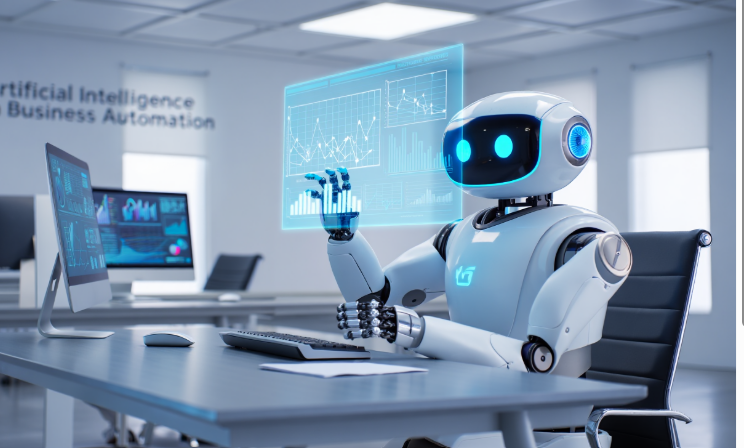
Artificial intelligence is rapidly moving beyond the experimental stage and becoming a core component of business strategy, with organizations across industries increasingly investing in AI to improve productivity, automate repetitive processes, strengthen decision-making, and create more personalized customer experiences. What was once viewed primarily as an emerging technology is now becoming an important part of digital transformation initiatives, as companies look for practical ways to integrate AI into everyday operations while maintaining security, accuracy, and human oversight.
The latest phase of AI adoption is being driven by the rapid development of generative AI, AI agents, machine learning platforms, and industry-specific intelligent applications. Businesses are increasingly exploring systems that can understand natural language, analyze large volumes of information, generate content, assist employees, and complete multi-step tasks with limited human intervention. Rather than using AI only as a chatbot or content-generation tool, organizations are beginning to view it as an operational technology capable of supporting entire workflows.
One of the most significant developments is the emergence of AI agents. Unlike traditional software applications that generally follow predefined instructions, AI-powered agents can interpret objectives, determine appropriate actions, interact with business systems, and complete sequences of tasks. In areas such as customer service, sales, finance, human resources, IT support, and marketing, these capabilities could significantly reduce the amount of manual work required from employees. For example, an AI agent could analyze a customer request, retrieve relevant information from a company’s knowledge base, prepare a response, update a CRM record, and escalate complex issues to a human employee.
The growing adoption of AI is also changing how businesses approach employee productivity. Instead of replacing every human task, many organizations are focusing on creating AI-assisted workplaces where employees can use intelligent tools to complete routine activities faster. Marketing teams can use AI to analyze campaign performance and develop content variations, sales teams can receive automated summaries of customer interactions, developers can use AI coding assistants to accelerate software development, and analysts can use AI to identify patterns across large datasets. This approach allows employees to spend more time on strategic, creative, and relationship-focused responsibilities.

Customer experience is another major area being transformed by AI. Businesses are deploying intelligent virtual assistants capable of providing support around the clock, answering frequently asked questions, recommending products, and guiding customers through services. More advanced systems can combine conversational AI with customer data and business applications to deliver more contextual interactions. As consumers increasingly expect fast and personalized digital experiences, AI is becoming an important tool for organizations attempting to meet those expectations at scale.
Healthcare, financial services, manufacturing, retail, logistics, and professional services are among the sectors where AI adoption is accelerating. In manufacturing, AI can support predictive maintenance, quality inspection, production optimization, and supply-chain forecasting. Financial institutions are applying AI to fraud detection, risk analysis, customer service, and financial intelligence. Retailers are using intelligent systems for demand forecasting, personalization, inventory management, and customer engagement. In healthcare, AI is being explored for clinical decision support, medical research, administrative automation, and patient communication.
However, the rapid expansion of AI is also creating new challenges for businesses. Organizations must address data privacy, cybersecurity, model accuracy, intellectual property, regulatory compliance, and ethical considerations before deploying AI at scale. AI systems can produce incorrect or misleading information, commonly referred to as hallucinations, making human validation particularly important in sensitive business processes. Companies also need clear governance policies defining how AI tools can access data, what information can be processed, and when human approval is required.
Another important concern is the security of enterprise AI systems. As organizations connect AI applications to internal databases, customer information, cloud platforms, and business applications, the potential impact of unauthorized access or misuse becomes greater. Businesses are therefore increasingly emphasizing identity management, access controls, data encryption, monitoring, audit trails, and secure AI development practices. The goal is not simply to adopt AI quickly, but to create an infrastructure that allows organizations to use it responsibly.
The workforce impact of AI is also becoming a central topic for business leaders. While automation may reduce demand for certain repetitive tasks, it is simultaneously creating demand for new skills related to AI management, data analysis, cybersecurity, automation, prompt engineering, AI governance, and digital transformation. Companies are therefore increasingly expected to invest in employee training and reskilling programs. The organizations most likely to benefit from AI may not necessarily be those that automate the most jobs, but those that successfully combine AI capabilities with human expertise.
For technology leaders, the challenge is shifting from asking whether their organization should adopt AI to determining where AI can deliver measurable business value. Successful implementation requires more than purchasing an AI tool. Businesses need clearly defined use cases, reliable data, appropriate technology infrastructure, employee training, security controls, and measurable performance indicators. Organizations that begin with specific operational problems and evaluate AI against measurable outcomes are more likely to achieve sustainable results than companies adopting AI simply because it is a popular technology trend.
The next stage of artificial intelligence is expected to be defined by deeper integration into business systems. AI will increasingly become embedded within CRM platforms, enterprise resource planning systems, productivity software, cybersecurity solutions, analytics platforms, and customer-facing applications. This could make AI less visible as a standalone technology and more like an intelligent layer operating across an organization’s digital infrastructure.
As AI capabilities continue to evolve, businesses are entering a period where intelligent automation, human expertise, and data-driven decision-making will increasingly operate together. The companies that establish responsible AI strategies, strengthen their data foundations, develop workforce capabilities, and focus on practical business outcomes will be better positioned to benefit from the technology. AI is no longer simply a futuristic concept—it is becoming a fundamental component of the modern enterprise, reshaping how organizations operate, compete, and deliver value to customers.
Have any thoughts?
Share your reaction or leave a quick response — we’d love to hear what you think!
-
 0
0 -
 0
0 -
 0
0 -
 0
0 -
 0
0 -
 0
0

